Rubia Homa, the Art of Scent
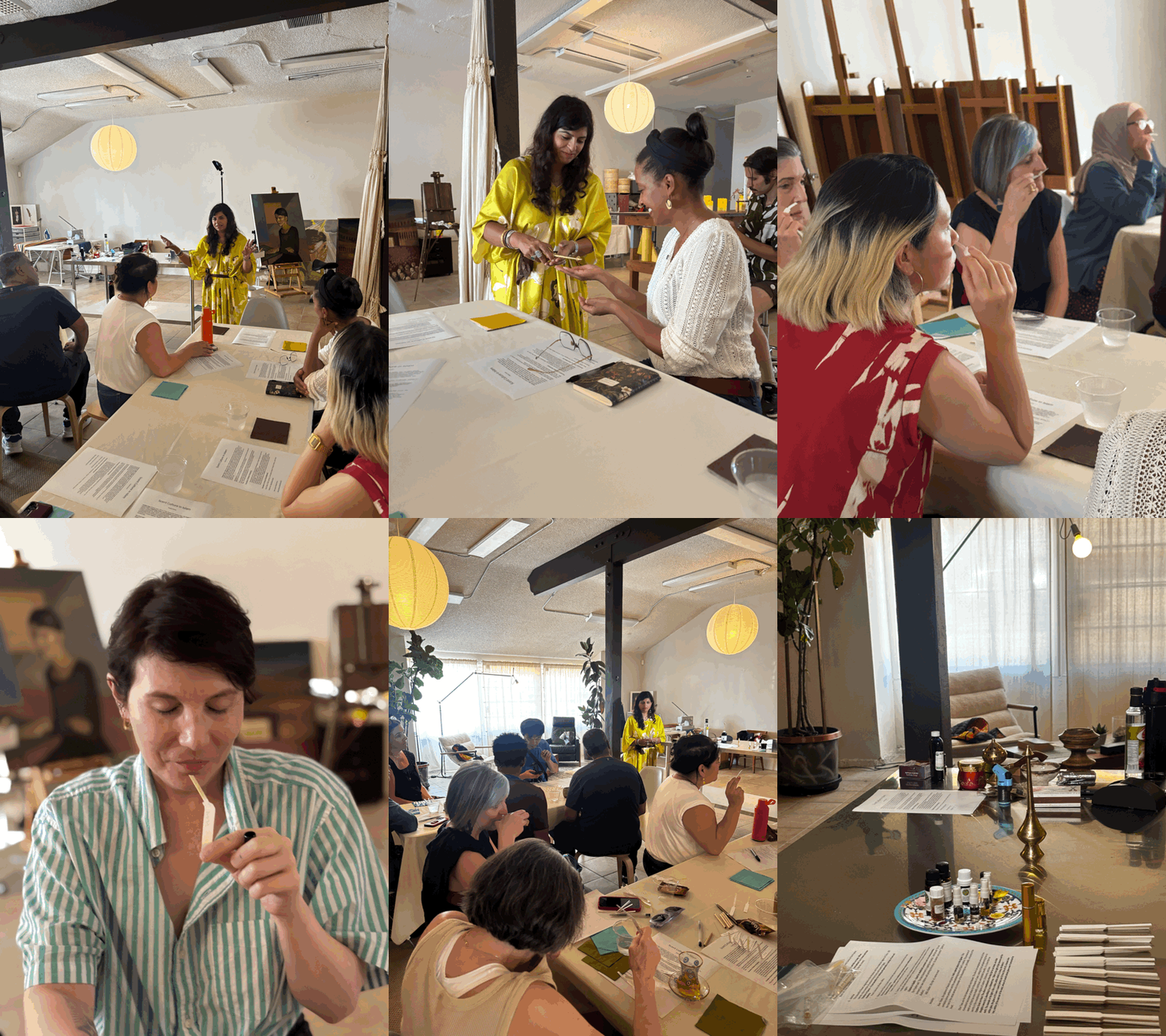
Last Saturday, we welcomed perfumer Rubia Homa of HURO Fragrances to Studios Colibrí for an afternoon devoted to something we rarely stop to study closely: scent.
Rubia took us on a sensory journey along the Silk Road and through the materials, rituals, and traditions of scent in Islamic cultures.
And we smelled A LOT:
Ginger, lemongrass, jasmine, rose, black cumin seed, camphor, frankincense, saffron, oud, musk, and I’m probably forgetting a few more.
We washed our hands with rose water, drank cardamom green tea, learned about bakhour and incense traditions, and spent the afternoon paying attention not only to the scents themselves, but to the histories, places, rituals, and material culture surrounding them.
Rubia had brought many of the raw materials with her. We handled pieces of frankincense resin harvested from trees, crystalline camphor traditionally obtained through the distillation of camphor wood, pieces of resinous agarwood used to produce oud, and the charcoal used to burn aromatic materials.
The materials led us in all sorts of directions. We talked about where they came from, the processes that turn them into the fragrances we recognize, and the different meanings they have acquired along the way. Camphor, for example, has been used for its antiseptic properties and plays a role in Islamic funerary practices. We also talked about jasmine and the very different associations a scent can acquire from one culture to another, from sexuality and sensuality in the West, to purity and virginity in the East.
And then there were our own associations.
As we passed everything around, people kept recognizing things they hadn't necessarily expected to recognize. A particular smell would suddenly remind someone of a place, a person, or something from childhood. Camphor, strangely enough, took me straight back to Cuba and the little anise candies I used to eat when I was a kid.
That became one of my favorite parts of the afternoon: moving back and forth between the history of these materials and our own histories with them.
This was also the first workshop at Colibrí led by a guest artist, something I have wanted to introduce since we opened the studio.
One of the ideas behind Colibrí has always been to bring different kinds of knowledge and practices into the same space. Drawing and painting are obviously part of that, but so are printmaking, textiles, natural dyes, pigments, photography, scent, sound, food, and other practices that might not ordinarily be taught alongside one another.
There are precedents for this kind of education that have been important to me. The Bauhaus made material experimentation fundamental to its preliminary courses, while Black Mountain College created an environment where artists working across different disciplines lived, learned, and worked in unusually close proximity.
I'm interested in what a small contemporary studio can take from that history.
Our block printing workshop approached pattern through repetition, rotation, and the physical act of printing. Our drawing courses have concentrated on observation, structure, light, and the relationship between the eye and the hand. Rubia's workshop took us somewhere entirely different, through resins, woods, spices, smoke, ritual, and memory.
These subjects are very different from one another, and that's precisely the point.
I want the guest workshops at Colibrí to continue expanding in that direction, bringing in people whose practices allow us to spend an afternoon looking closely at something we might otherwise know very little about.
Thank you to everyone who joined us, and especially to Rubia for sharing so generously with us and for inaugurating this part of the studio's program.
This was our first guest workshop.
Definitely not our last.
See you at the studio